What is OpenAI Codex?
OpenAI Codex is an advanced AI coding assistant designed to function as a collaborative partner for developers. It goes beyond simple code generation to understand entire repositories, execute commands safely in sandboxed environments, and transform issues into production-ready pull requests. Built on OpenAI's powerful GPT-5.2-Codex model, it operates as a multi-agent system capable of handling parallel workflows across projects. Codex integrates into various development environments including dedicated apps, IDEs, and command-line interfaces, all synchronized through a user's ChatGPT account. Its core purpose is to automate and accelerate engineering work, from building features and migrations to code review and documentation, effectively acting as an always-on team member that raises code quality and development velocity.
Main Features
1. End-to-End Task Completion: Reliably handles complex software engineering tasks from start to finish, including feature building, refactoring, and migrations.
2. Multi-Agent Workflows: Functions as a command center with built-in worktrees and cloud environments, enabling parallel agent work across multiple projects.
3. Repository Intelligence: Rapidly understands codebase context and structure to provide relevant, informed assistance.
4. Safe Execution Sandbox: Executes code and commands in isolated environments to prevent system risks.
5. Automated Background Work: Through Automations, it performs routine tasks like issue triage, alert monitoring, and CI/CD without constant prompting.
6. Team Skill Adaptation: Learns and applies team-specific standards for coding, prototyping, and documentation via customizable Skills.
7. Integrated Code Review: Provides thorough, high-signal code reviews to catch issues early and improve baseline quality.
8. Multi-Surface Accessibility: Available through a dedicated app, IDE extensions, and a command-line interface (CLI) for seamless workflow integration.
Use Cases
1. Automated Feature Development: Transforming user stories or issue descriptions into fully implemented, reviewed pull requests.
2. Complex Code Refactoring: Safely restructuring and modernizing large codebases, such as implementing dark mode across a project.
3. Routine Maintenance Automation: Setting up automations for daily tasks like checking for system crashes (e.g., Sentry), bug fixes, and monitoring.
4. Rapid Prototyping: Generating code for new features or proofs of concept based on high-level prompts.
5. Code Review & Quality Assurance: Reviewing pull requests to identify high-risk issues and ensure adherence to team standards.
6. Documentation Generation: Creating or updating technical documentation aligned with the current codebase.
7. Migration Assistance: Managing database or framework upgrades and other complex system migrations.
8. CI/CD Pipeline Management: Automating build processes, testing, and deployment checks.
Supported Languages
1. The tool is designed to work with code and repositories across all major programming languages. While the reference material does not list specific languages, AI models like Codex typically support popular languages such as Python, JavaScript, Java, C++, Go, Ruby, PHP, and more for code generation and understanding.
Pricing Plans
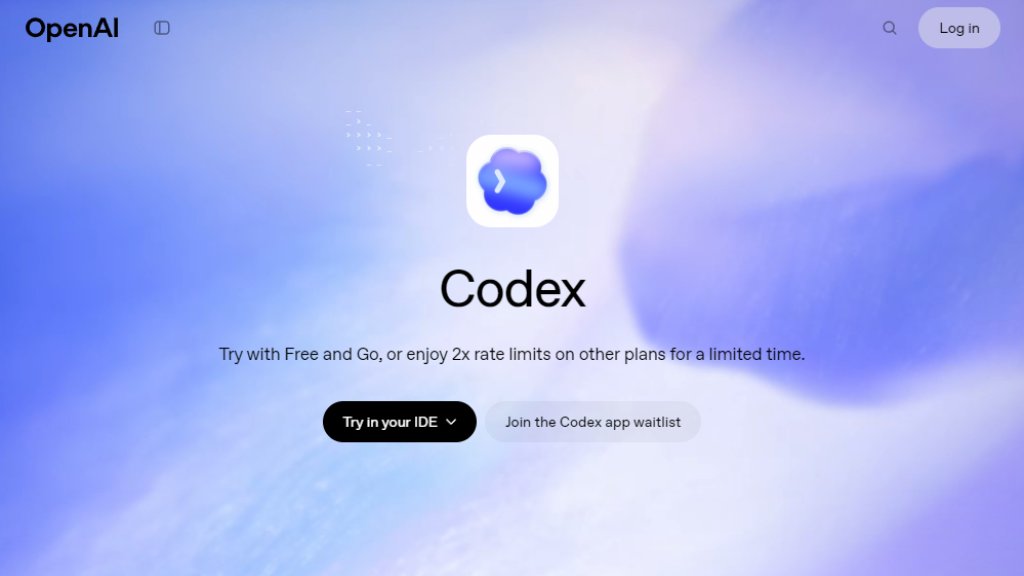
1. The website promotes a 'Try with Free and Go' option, indicating a free tier is available.
2. It mentions 'other plans' and '2x rate limits on other plans for a limited time,' confirming the existence of paid plans.
3. Specific pricing details, numbers, or structures for these paid plans are not listed on the provided page.
Frequently Asked Questions
1. Q: What is the Codex app?
A: The Codex app is your AI pair programmer, a command center for agentic coding designed to drive real engineering work from routine tasks to complex problems.
2. Q: How does Codex work?
A: Codex understands your repository, executes commands safely in a sandbox, and turns issues into reviewed, production-ready pull requests using OpenAI's frontier coding models.
3. Q: Where can I use Codex?
A: You can use Codex across multiple surfaces: start in the dedicated Codex app, move to your IDE with extensions, or continue in the terminal via the CLI, all connected by your ChatGPT account.
4. Q: What are Automations in Codex?
A: Automations allow Codex to work unprompted on background tasks like issue triage, alert monitoring, and CI/CD, so developers can stay focused on building.
Pros and Cons
Pros:
- Drives real, complex engineering work from start to finish, not just code snippets.
- Powerful multi-agent system for parallel project work, significantly speeding up development cycles.
- Deeply integrates into the development workflow through apps, IDEs, and CLI.
- Enhances code quality with thorough reviews and adherence to team standards.
- Automates routine background tasks, freeing developer time.
Cons:
- Specific pricing for paid plans is not transparently listed on the main page.
- Access to the ful



Please login to post a comment
Login