What is Dropstone?
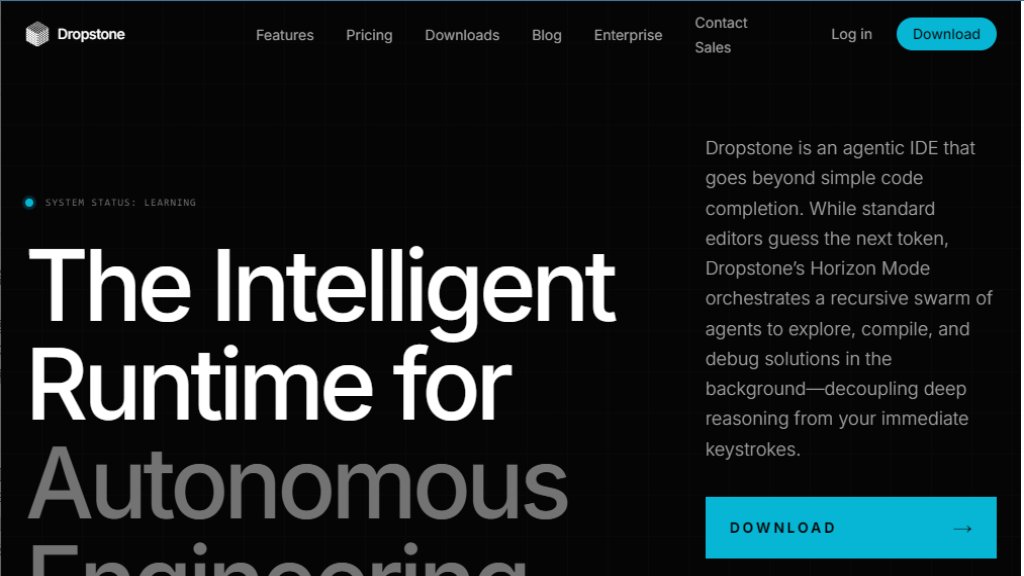
Dropstone is an advanced, agentic integrated development environment (IDE) designed for autonomous software engineering. It is not a basic code completion tool. Instead, it functions as an intelligent runtime that orchestrates a recursive swarm of AI agents to perform deep reasoning, exploration, and problem-solving in the background. Built as a fork of VS Code, it offers a familiar interface powered by its proprietary D3 Engine and Horizon Mode. This architecture decouples deep reasoning from user input, allowing the system to explore thousands of potential solutions, compile, debug, and verify code autonomously over extended periods (24+ hours). Its core innovation is overcoming the "linearity barrier" of standard AI models by using parallelized agent swarms to search a vast solution space, ensuring higher-quality, verified outputs.
Main Features
1. Horizon Mode: This is the core autonomous reasoning engine. It deploys a recursive swarm of thousands of lightweight "Scout" agents to explore divergent solution paths in parallel before converging on the best result.
2. Infinite Context via State Virtualization: The D3 Engine decouples logic and state from raw text, using a virtualized memory system. This allows the tool to reference millions of tokens of context—like chats, docs, and code—without performance degradation.
3. Automated Verification & Safety: A multi-layered "Deterministic Envelope" automatically verifies code. This includes syntax checking, static security analysis (SAST), functional testing in sandboxes, and property-based fuzzing to catch edge cases.
4. Adaptive Learning & Negative Knowledge Propagation: The system learns from user corrections and, crucially, from agent failures. When a scout agent hits a dead end, it broadcasts a "failure vector" so the entire swarm avoids that path, enabling fast collective learning.
5. Collaborative Context & Shared Workspace: For teams, it synchronizes reasoning states and decision history across members, enabling real-time collaboration, code review cycles, and shared knowledge meshes.
6. Semantic Entropy Tracking for Hallucination Reduction: The system monitors output perplexity in real-time. If it detects a spike indicating potential hallucination, it triggers a state reset to prune the erroneous branch, maintaining output reliability.
Use Cases
1. Complex System Refactoring: Ideal for restructuring large, intricate codebases (50k+ LOC) by autonomously analyzing architecture, identifying debt, and generating safe migration paths.
2. Deep Debugging and Bug Hunting: The swarm can explore low-probability execution paths to find obscure, hard-to-replicate bugs and security vulnerabilities that linear analysis would miss.
3. Greenfield Project Development: From a specification, Dropstone can explore vast algorithmic solution spaces to generate and verify initial prototypes and system architectures.
4. Automated Code Review and QA: It acts as a continuous, automated QA department by running generated or human-written code through its hierarchical verification stack (syntax, security, functional tests).
5. Long-Horizon Engineering Tasks: Suitable for projects that require continuous, recursive reasoning over many hours or days, such as verifying cryptographic protocols or synthesizing complex algorithms, without context loss.
6. Team-Based Software Development: Facilitates collaborative engineering by providing a shared, immutable graph of decision states, making team reasoning and review processes transparent and efficient.
Frequently Asked Questions
1. Q: What is the "Linearity Barrier" that Dropstone solves?
A: Standard AI models process prompts and context in a linear sequence. As tasks get longer and more complex, their reasoning quality degrades as the context window fills up. Dropstone's recursive swarm architecture breaks this linearity by exploring many solution paths in parallel, enabling deep reasoning over long horizons without degradation.
2. Q: How does Dropstone prevent AI hallucinations in generated code?
A: It uses multiple techniques: a Flash-Gated Consensus protocol where agents verify each other's logic, real-time Semantic Entropy Tracking to detect and prune incoherent outputs, and a rigorous, automated 4-layer verification stack (syntax, security, function, fuzzing) before code is presented to the user.
3. Q: Is Dropstone a standalone editor or an extension?
A: It is deployed as a fully compatible fork of Visual Studio Code. This provides a standard, zero-learning-curve interface while being powered by the proprietary Dropstone D3 Runtime and Horizon Mode in the background.
4. Q: Who is responsible for the code generated by Dropstone?
A: According to the terms, the output is non-deterministic and the user retains full responsibility for reviewing, compiling, and deploying any generated code. Blankline (the developer) disclaims liability for downstream failures or vulnerabilities.
Pricing Plans
1. Free Plan: Offers the



Please login to post a comment
Login